
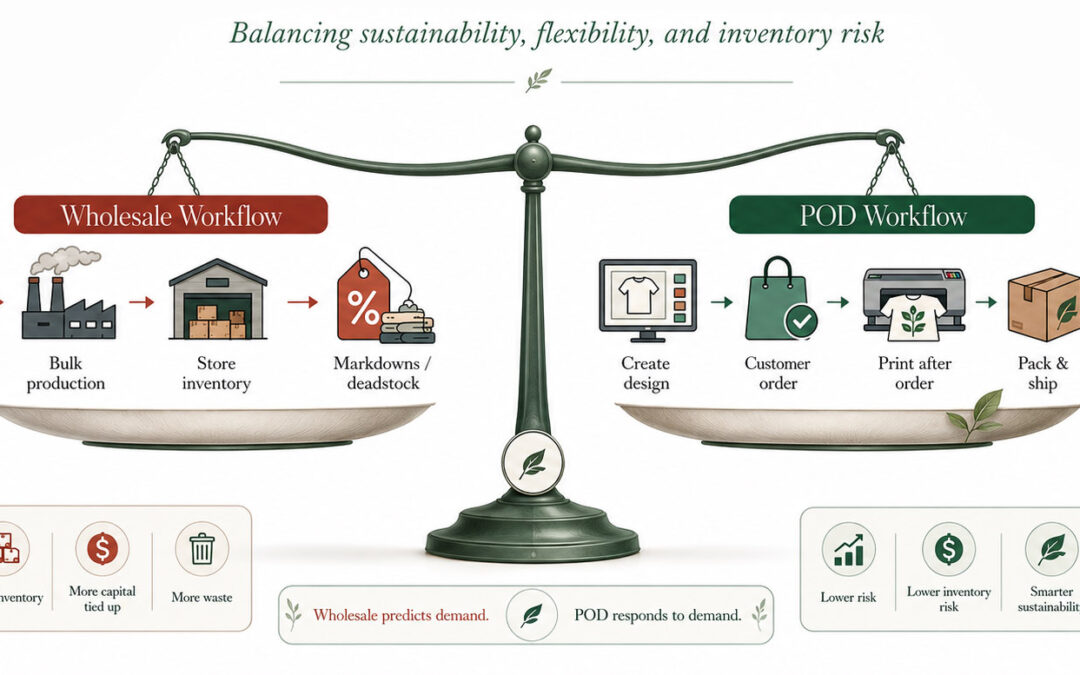
Print on Demand vs Wholesale: Why Made-to-Order Printed Clothing Is a More Sustainable Fashion Workflow
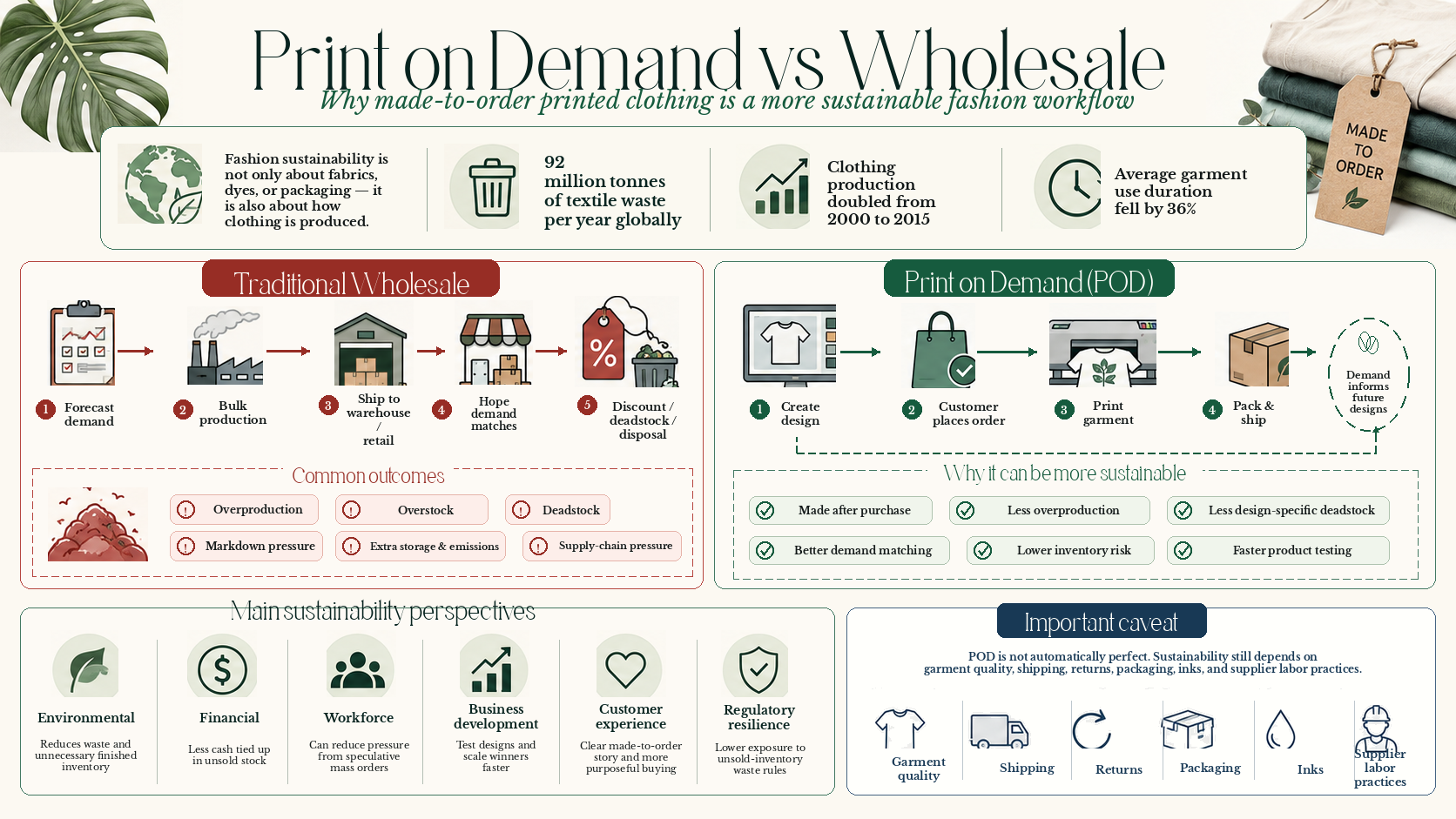
Fashion’s sustainability problem is not only about fabrics, dyes, or packaging. It is also about how clothing is produced in the first place.
For decades, the traditional wholesale model has worked like this: brands predict what customers might buy months in advance, manufacture or purchase large batches, ship those products into warehouses or retail stores, and then hope demand matches the forecast. When it works, wholesale can be efficient. But when it fails, the result is familiar across the fashion industry: overstock, markdowns, deadstock, landfill waste, unnecessary emissions, and pressure throughout the supply chain.
Print on demand, often shortened to POD, offers a different logic. Instead of printing hundreds or thousands of garments before anyone has bought them, a POD workflow produces the finished printed garment after a customer places an order. For printed apparel such as T-shirts, hoodies, sweatshirts, tote bags, activewear, and accessories, this changes the sustainability equation in a meaningful way.
This does not mean print on demand is automatically perfect. The blank garment still has an environmental footprint. Shipping, packaging, returns, ink choice, garment quality, and supplier labor practices still matter. But compared with the conventional wholesale model, POD can be a more sustainable workflow because it attacks one of fashion’s biggest problems at the source: making too much product before there is real demand.
Global textile waste remains a major issue. UNEP reported that around 92 million tonnes of textile waste are produced globally each year, while clothing production doubled from 2000 to 2015 and the average duration of garment use decreased by 36%. (UNEP - UN Environment Programme) In the United States alone, the EPA estimated that 17 million tons of textiles were generated in municipal solid waste in 2018, with 11.3 million tons landfilled. (US EPA)
That is the background. Now let’s look at why the print on demand workflow is often more sustainable from multiple points of view: environmental, financial, workforce, business development, customer experience, and regulatory resilience.
1. The Core Difference: Wholesale Predicts Demand, POD Responds to Demand
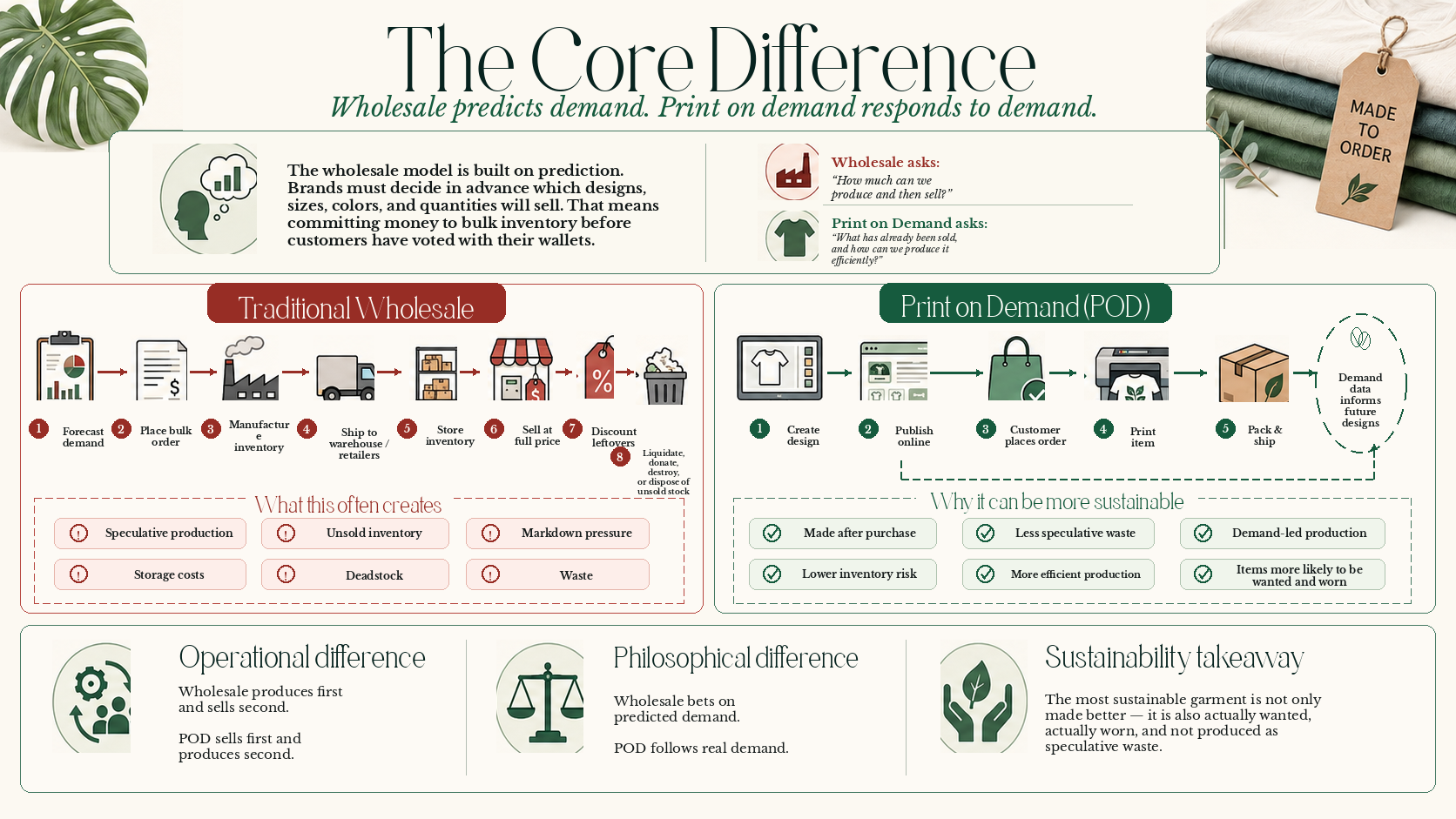
The wholesale model is built on prediction. A brand must decide in advance which designs, sizes, colors, and quantities will sell. That usually means committing money to bulk inventory before customers have voted with their wallets.
A simplified wholesale workflow looks like this:
Forecast demand → place bulk order → manufacture inventory → ship to warehouse or retailers → store inventory → sell at full price → discount leftovers → liquidate, donate, destroy, or dispose of unsold stock.
A print on demand workflow looks very different:
Create design → publish product online → customer places order → item is printed → item is packed and shipped.
The difference may sound operational, but it is actually philosophical. Wholesale asks, “How much can we produce and then sell?” Print on demand asks, “What has already been sold, and how can we produce it efficiently?”
That shift matters because the most sustainable garment is not just the one made from better materials. It is also the one that is actually wanted, actually worn, and not produced as speculative waste.
2. Environmental Point of View: Less Overproduction, Less Deadstock, Less Waste
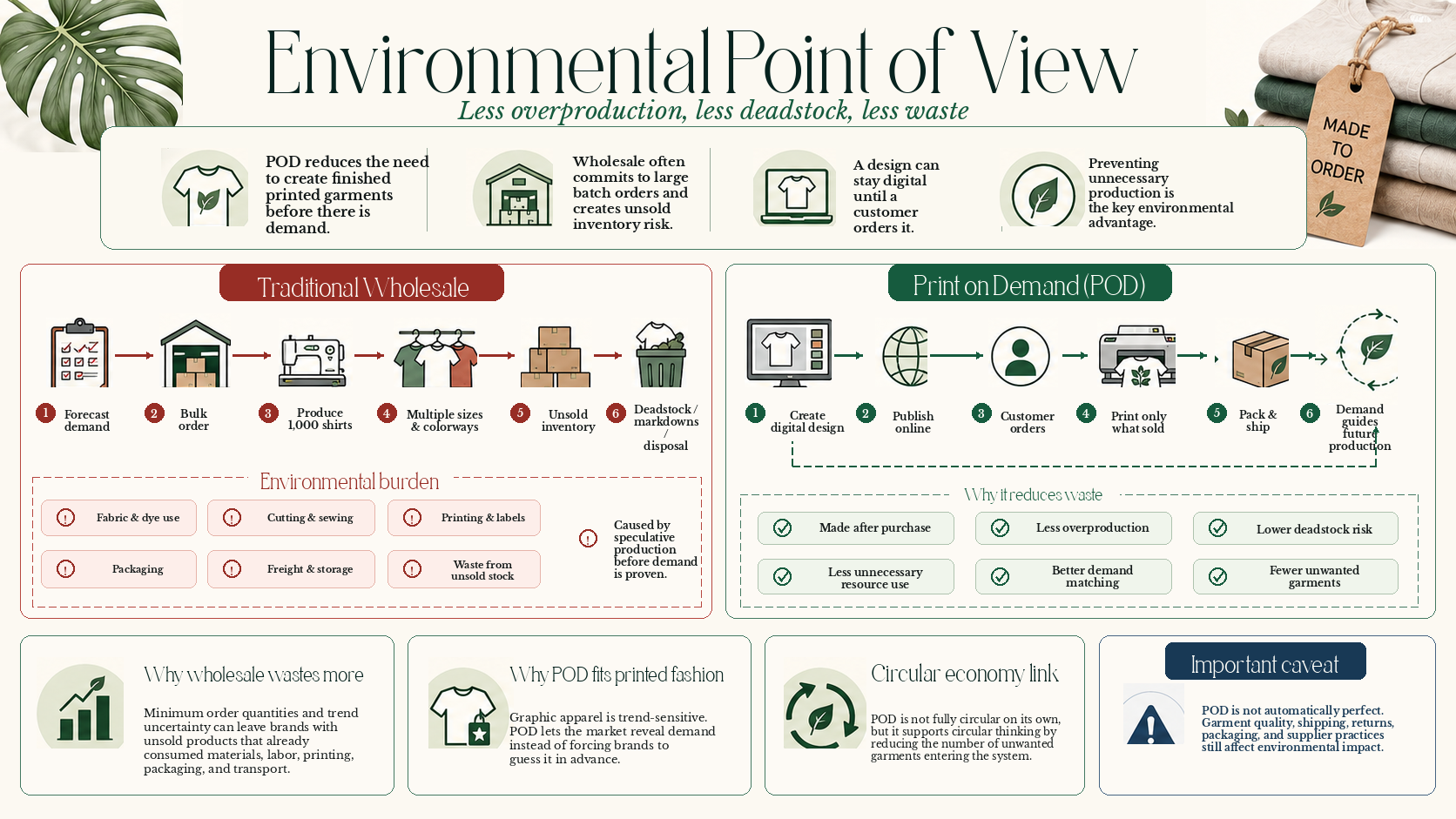
The strongest environmental argument for print on demand is simple: POD reduces the need to create finished printed garments before there is demand.
In wholesale apparel, overproduction is baked into the system. A brand may order 1,000 shirts in five sizes and four colorways because minimum order quantities make smaller orders expensive. If one design does not sell, if a color underperforms, or if sizing demand was misjudged, the brand is left with unsold inventory. That inventory still required fabric, dyeing, cutting, sewing, printing, labeling, packaging, freight, storage, and labor.
Print on demand removes much of that risk. A design can exist digitally until someone orders it. The brand does not need to print 500 hoodies just to discover that customers only wanted 43 of them. The environmental advantage comes from preventing unnecessary production before it happens.
This is especially important for printed clothing because designs are trend-sensitive. A graphic tee connected to a meme, season, event, aesthetic, or niche community may have a short demand window. Wholesale forces the brand to guess the size of that window. POD lets the market reveal it.
The circular economy argument is similar. The Ellen MacArthur Foundation describes today’s fashion industry as linear and argues that circular fashion should eliminate waste and pollution, keep products and materials in use, and regenerate nature. It also notes that discarded garments represent lost financial value for both producers and customers. (Ellen MacArthur Foundation) POD is not a complete circular system on its own, but it supports circular thinking because it reduces the volume of unwanted products entering the system in the first place.
3. Digital Printing Can Reduce Process Waste Compared With Traditional Printing
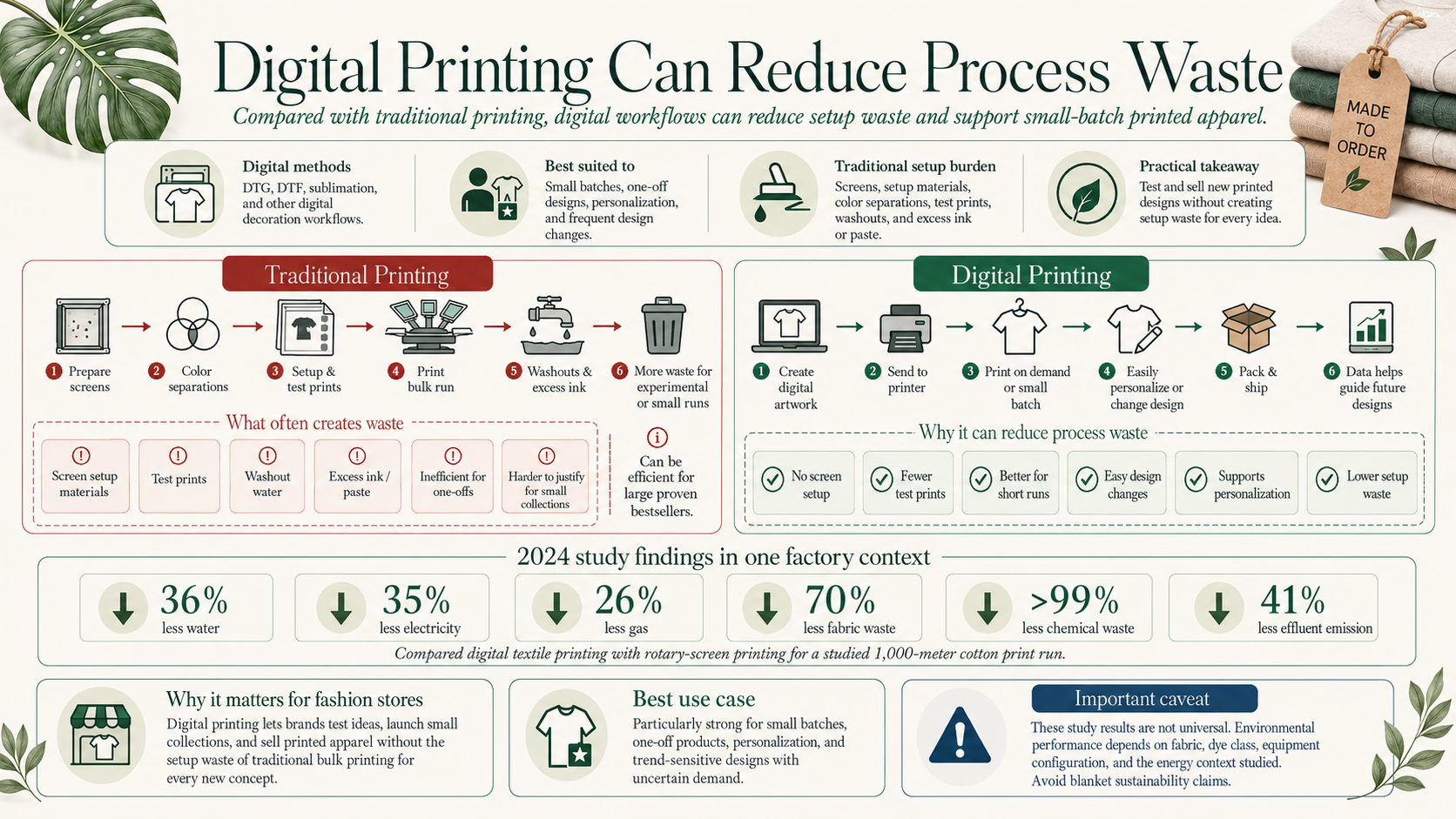
Many print on demand workflows rely on digital methods such as direct-to-garment printing, direct-to-film transfer, sublimation, or other digital decoration processes. These methods are often better suited for small batches, one-off designs, personalization, and frequent design changes.
Traditional screen printing can be efficient for large runs, but it often requires screens, setup materials, color separations, test prints, washouts, and excess ink or paste. For a large proven bestseller, that setup may be worth it. For experimental designs, small collections, or personalized products, the waste can be harder to justify.
A 2024 study comparing rotary-screen printing with digital textile printing in a factory context found that digital textile printing performed better across several environmental measures for the studied 1,000-meter cotton print run. The digital process used 36% less water, 35% less electricity, 26% less gas, 70% less fabric waste, more than 99% less chemical waste, and 41% less effluent emission than rotary-screen printing in that specific research context. (Sage Journals) The study’s authors also noted that the results were limited to the fabric, dye class, equipment configuration, and energy context studied, which is important: no printing method should be marketed with universal sustainability claims. (Sage Journals)
For a fashion store selling printed clothing, the takeaway is practical: digital print workflows allow you to test and sell designs without creating the setup waste of traditional bulk printing for every new idea.
4. POD Reduces the “Hidden Footprint” of Warehousing and Inventory Management
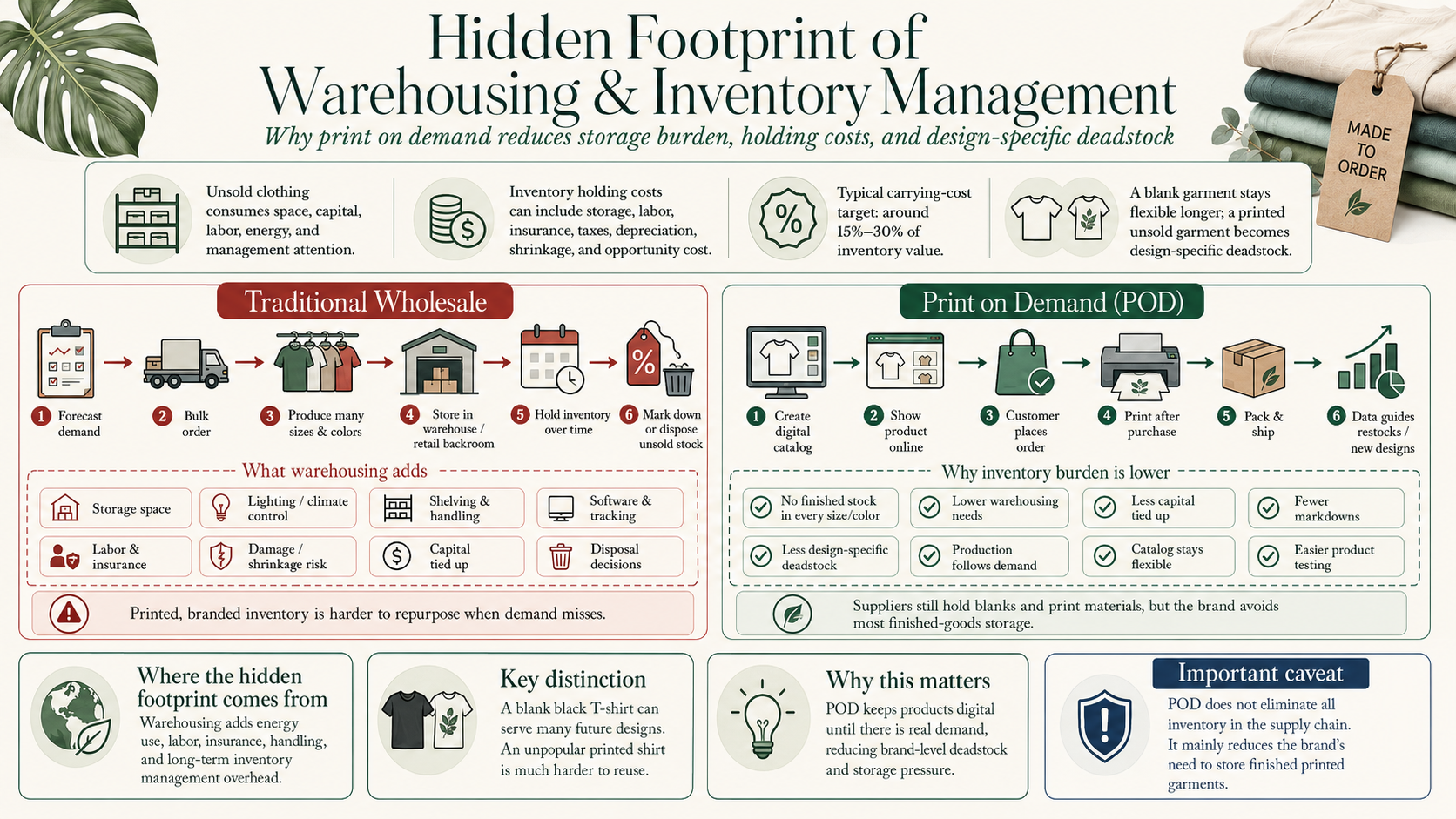
Unsold clothing does not just sit quietly. It consumes space, capital, labor, energy, and management attention.
Wholesale inventory must often be stored in warehouses, retail backrooms, fulfillment centers, or distributor facilities. Storage brings lighting, heating or cooling, shelving, handling, software, labor, insurance, shrinkage, damage risk, and eventually markdown or disposal decisions. Inventory holding costs include storage, labor, insurance, taxes, depreciation, shrinkage, and opportunity cost; one retail inventory guide notes that many brands aim for carrying costs around 15% to 30% of total inventory value. (Cogsy)
POD reduces that burden because the brand is not storing finished printed garments in every size and color. Instead, the store carries a digital catalog and relies on production after purchase. This does not eliminate all inventory from the supply chain, because suppliers still stock blank garments and printing materials, but it avoids the brand-level problem of printed, branded, design-specific deadstock.
That distinction is important. A blank black T-shirt can be used for many designs. A black T-shirt printed with an unpopular graphic is much harder to repurpose. POD keeps the product flexible for longer.
5. Financial Point of View: Lower Risk, Healthier Cash Flow, Smarter Capital Allocation
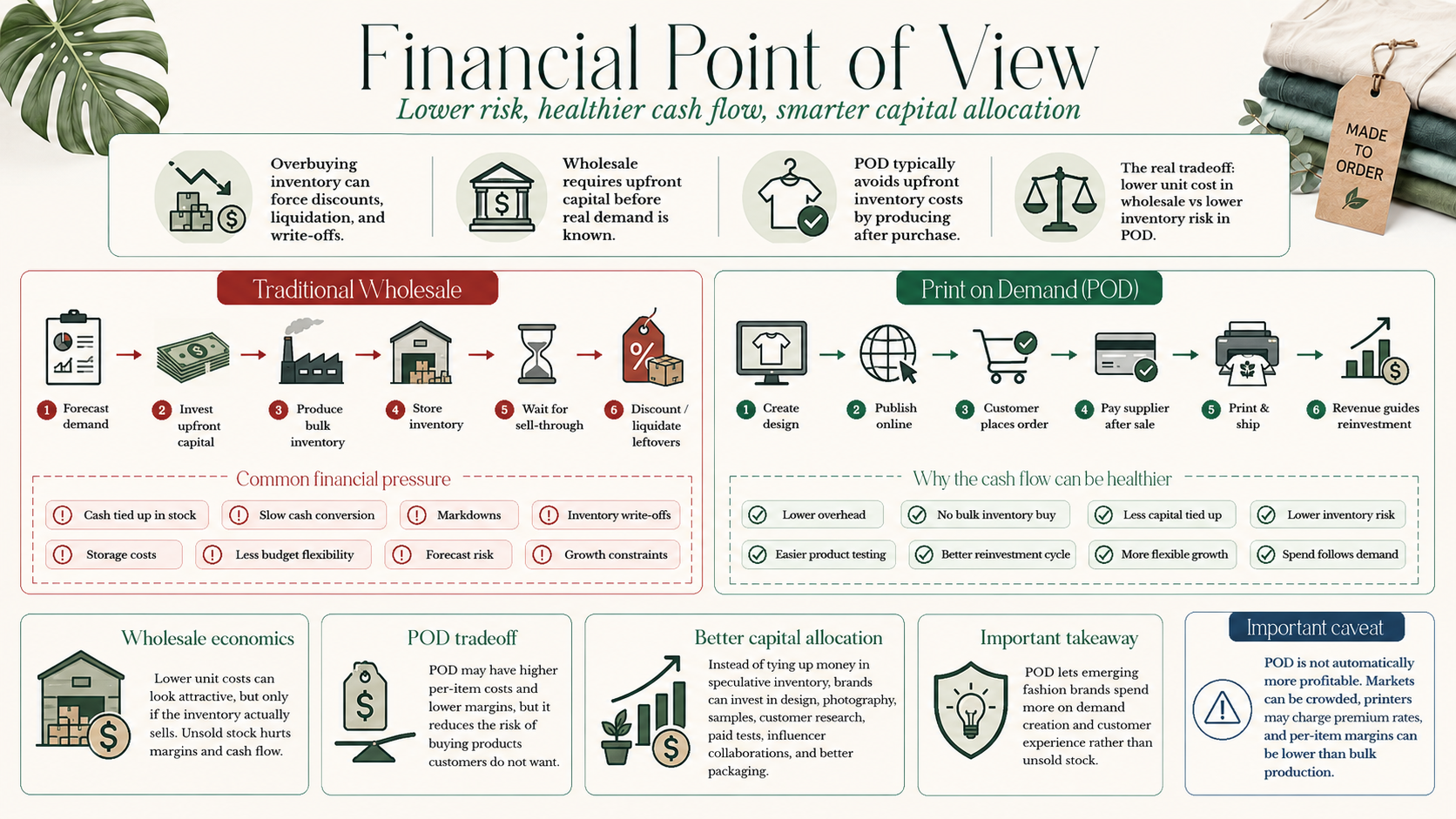
Sustainability and financial health are connected. A business that overbuys inventory often has to discount aggressively, liquidate stock, or write off products. That is bad for margins and bad for the planet.
Wholesale requires upfront capital. A store owner has to pay for inventory before knowing exactly what will sell. That money is then trapped in physical stock. If the products move slowly, the brand may not have enough cash left for marketing, content, photography, customer service, product development, or better materials.
Print on demand changes the cash-flow model. Shopify describes POD as having lower overhead than traditional mass production because business owners typically pay the printer only after a customer places an order, avoiding upfront inventory costs. Shopify also notes the tradeoff: POD markets can be crowded, printers may charge premium rates, and per-item margins may be lower than bulk production. (Shopify)
That tradeoff is exactly where POD’s financial sustainability becomes interesting. Wholesale may offer a lower unit cost, but only if the inventory sells. POD may have a higher unit cost, but it reduces the risk of buying products customers do not want.
For an emerging fashion store, that can be the difference between growth and cash-flow stress. Instead of investing thousands in speculative inventory, the brand can invest in:
better design work, stronger product photography, samples for quality control, paid advertising tests, influencer collaborations, customer research, improved size guides, better packaging, and content that builds long-term brand value.
In other words, POD lets a brand spend money on demand creation and customer experience rather than tying it up in unsold stock.
6. Workforce Point of View: A More Responsible Workflow Can Reduce Pressure, But Only If Managed Well
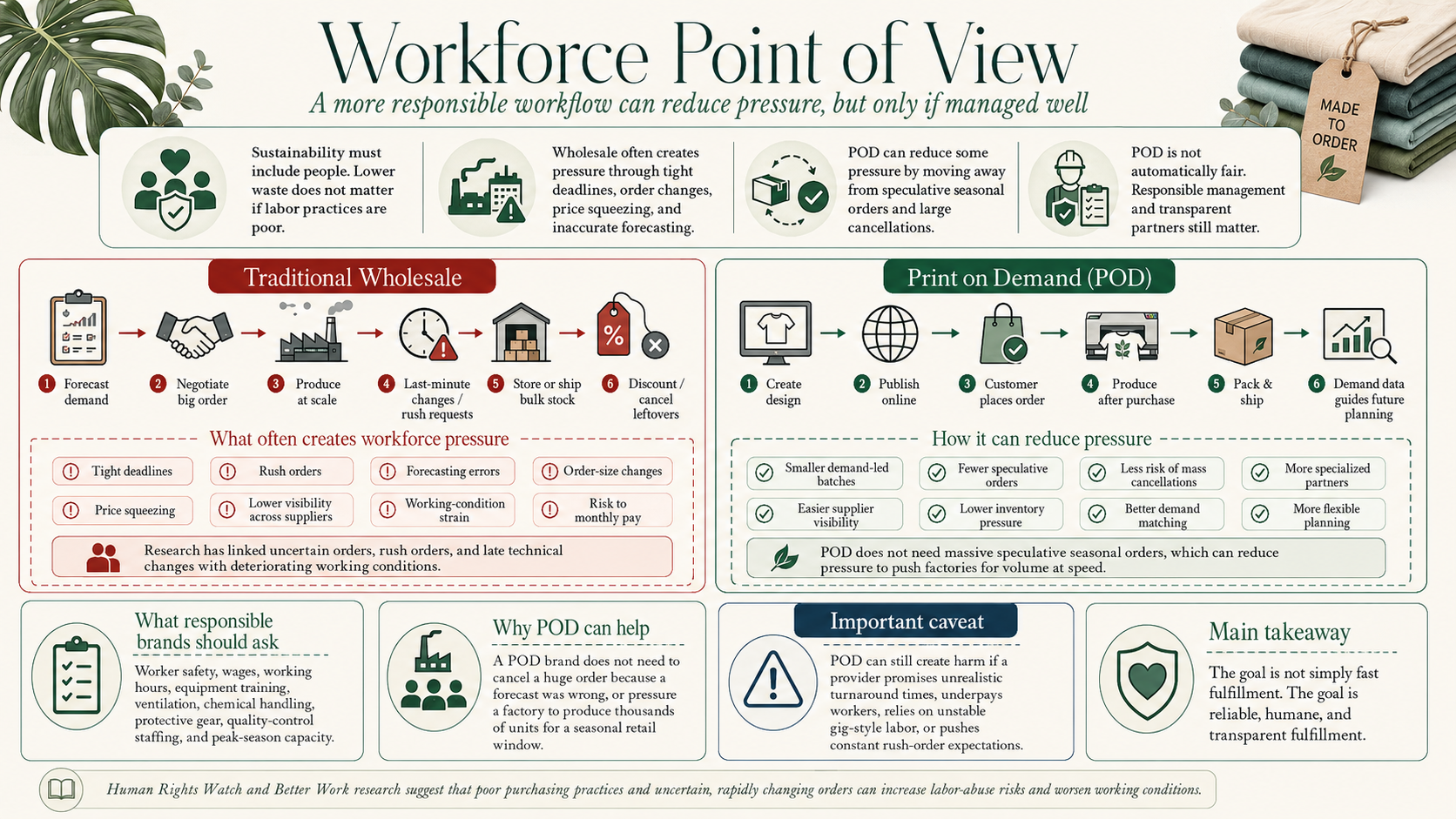
Sustainability must include people. A product is not truly sustainable if it reduces waste but depends on poor labor practices.
The wholesale fashion system often creates pressure through tight deadlines, last-minute order changes, price squeezing, and inaccurate forecasting. Human Rights Watch has reported that poor purchasing practices by apparel brands can be a root cause of labor abuses in factories, and that low purchase prices, shorter manufacturing times, poor forecasting, unfair penalties, and poor payment terms can increase labor-abuse risks. (Human Rights Watch)
Better Work research has also linked problematic sourcing practices to deteriorating working conditions. In a study of Cambodian garment factories, uncertain orders, changes in order size, rush orders, and changes to technical requirements after production had started were associated with negative impacts on working conditions; changes in order size were also found to decrease workers’ monthly pay.
Print on demand can help reduce some of these pressures because it moves away from massive speculative seasonal orders. A POD brand does not need to cancel a large order because a forecast was wrong. It does not need to pressure a factory to produce thousands of units quickly just to hit a seasonal retail window. It can also work with fewer, more specialized production partners, making supplier visibility easier than in a fragmented wholesale chain.
However, POD is not automatically fair. If a print provider promises unrealistic turnaround times, underpays workers, relies on unstable gig-style labor, or pushes employees to meet constant rush-order expectations, the model can still create harm.
A responsible POD fashion brand should ask production partners about worker safety, wages, working hours, equipment training, ventilation, chemical handling, protective gear, quality-control staffing, and peak-season capacity. The goal is not simply “fast fulfillment.” The goal is reliable, humane, and transparent fulfillment.
7. Business Development Point of View: POD Helps Brands Learn Faster and Waste Less
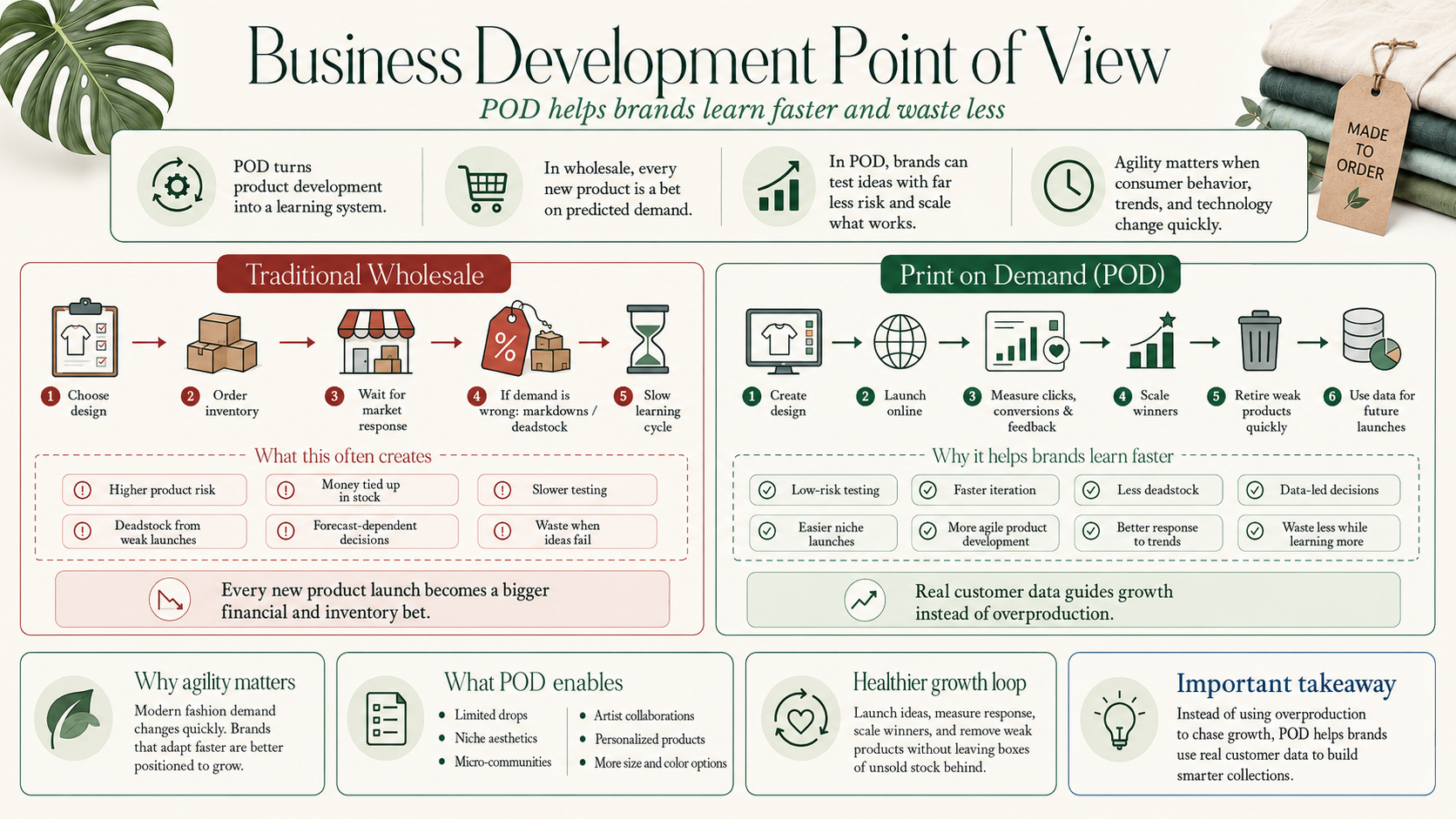
From a business development perspective, print on demand is powerful because it turns product development into a learning system.
In wholesale, every new product is a bet. You choose a design, order inventory, and wait to see whether the market agrees. If the bet is wrong, the business pays in both money and waste.
In POD, a design can be tested with far less risk. A brand can launch multiple concepts, measure clicks, conversion rates, customer feedback, return rates, and repeat purchases, then scale the winners. Products that do not resonate can be removed from the store without leaving boxes of deadstock behind.
This is especially valuable for a modern fashion store because demand changes quickly. McKinsey’s State of Fashion 2026 notes that the industry is operating in an environment where trade, consumer behavior, and technology remain in flux, and that agile brands able to adapt quickly are likely to emerge as winners. (McKinsey & Company)
POD supports that agility. It allows a brand to:
launch limited drops without overcommitting, test niche aesthetics, create products for micro-communities, collaborate with artists or creators, personalize products, offer broader size or color options, respond to cultural moments, and retire underperforming designs quickly.
This creates a healthier growth loop. Instead of using overproduction to chase growth, the brand uses real customer data.
8. POD Can Support More Inclusive and Niche Product Strategy
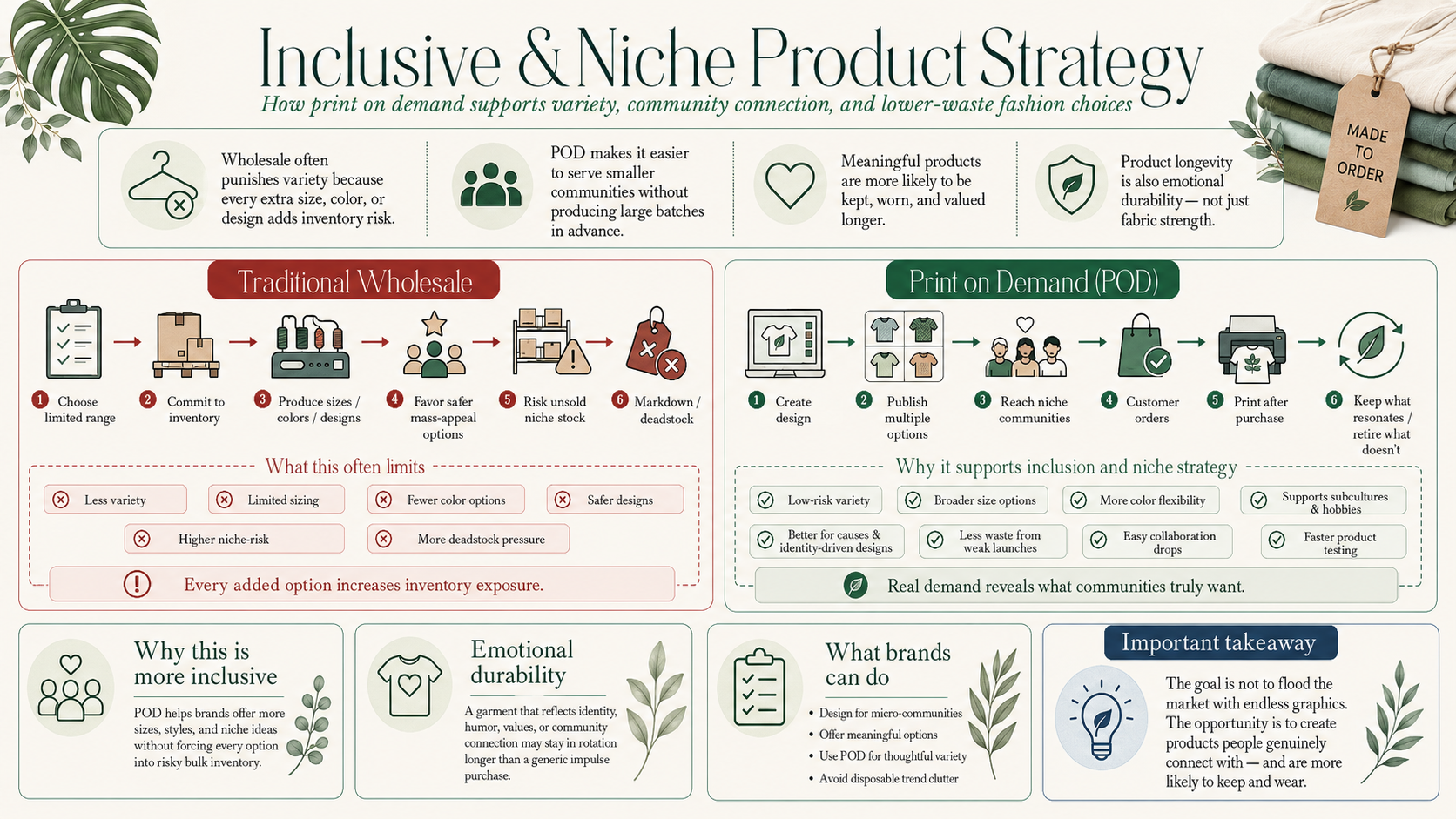
Wholesale often punishes variety. Every additional size, color, or design requires inventory risk. That can push brands toward narrow product ranges, limited sizing, and “safe” designs that appeal to the widest possible audience.
Print on demand makes it easier to serve smaller communities without waste. A store can offer designs for specific subcultures, hobbies, identities, aesthetics, or causes without producing large batches in advance. This is not only a business advantage; it can also be a sustainability advantage because products with personal meaning are more likely to be kept, worn, and valued.
A generic shirt bought on impulse may be discarded quickly. A printed garment that expresses a customer’s identity, humor, values, or community connection may stay in rotation longer. Product longevity is not only about fabric strength. It is also about emotional durability.
For a fashion brand, this is a major opportunity: use POD not to flood the internet with disposable graphics, but to create designs customers genuinely connect with.
9. Regulatory Point of View: Inventory Waste Is Becoming a Business Risk
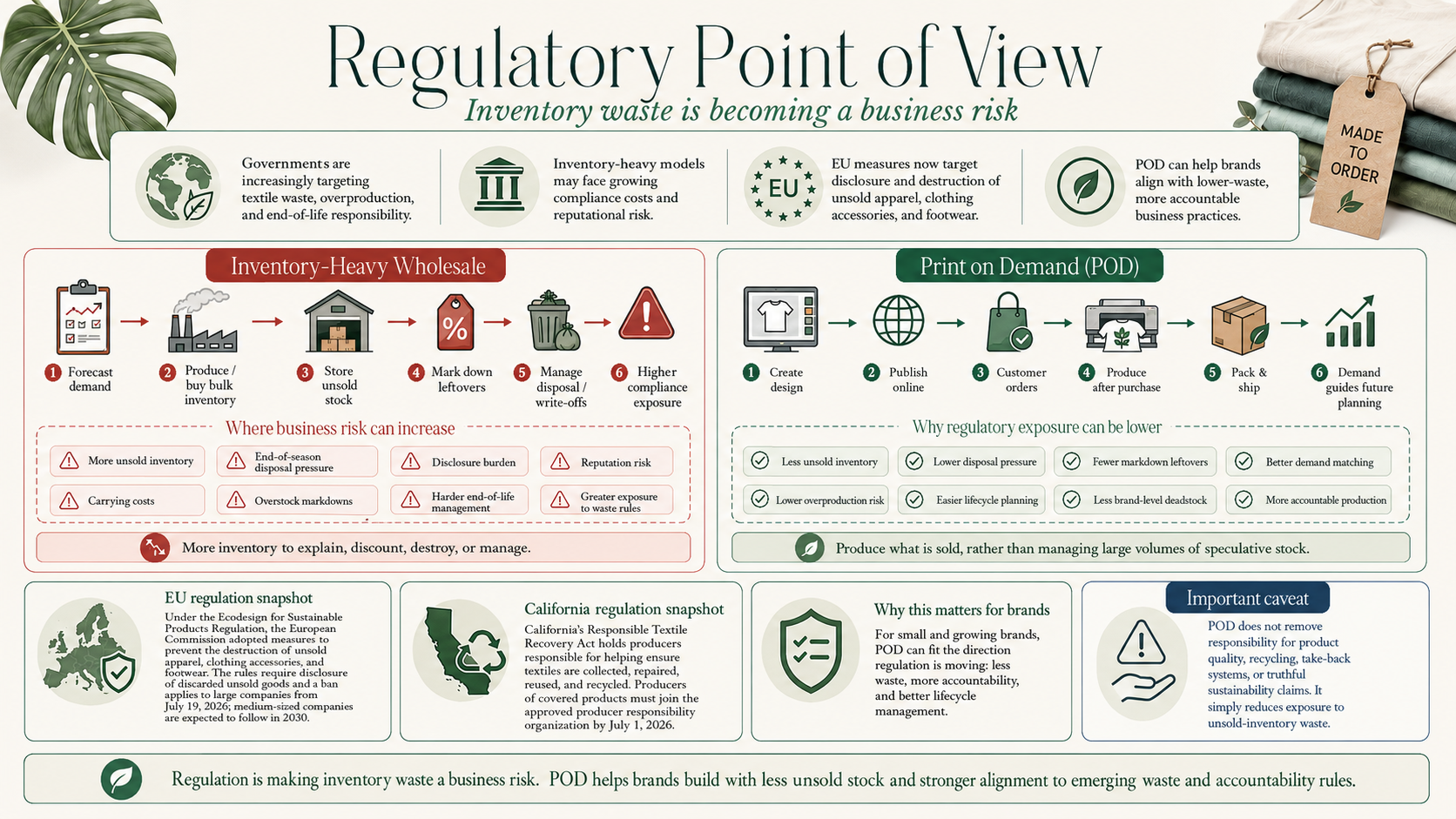
Governments are increasingly targeting textile waste, overproduction, and end-of-life responsibility. That means inventory-heavy business models may face growing compliance costs and reputational risk.
The European Commission adopted measures under the Ecodesign for Sustainable Products Regulation to prevent the destruction of unsold apparel, clothing accessories, and footwear. The rules require disclosure of discarded unsold goods and introduce a ban on the destruction of unsold apparel and footwear, applying to large companies from July 19, 2026, with medium-sized companies expected to follow in 2030. (Environment)
California has also moved toward textile producer responsibility. CalRecycle states that the Responsible Textile Recovery Act holds the apparel and textile industry responsible for ensuring products are collected, repaired, reused, and recycled; producers of covered products must join the approved producer responsibility organization by July 1, 2026. (CalRecycle Home Page)
For small and growing brands, POD can be a way to build with these regulatory trends in mind. A brand that produces only what customers order has less unsold inventory to explain, discount, destroy, or manage at end of season.
This does not remove responsibility for product quality, recycling, take-back systems, or truthful sustainability claims. But it does align the business model with the direction regulation is moving: less waste, more accountability, and better lifecycle management.
10. Customer Experience Point of View: Transparency Can Become Part of the Brand Story
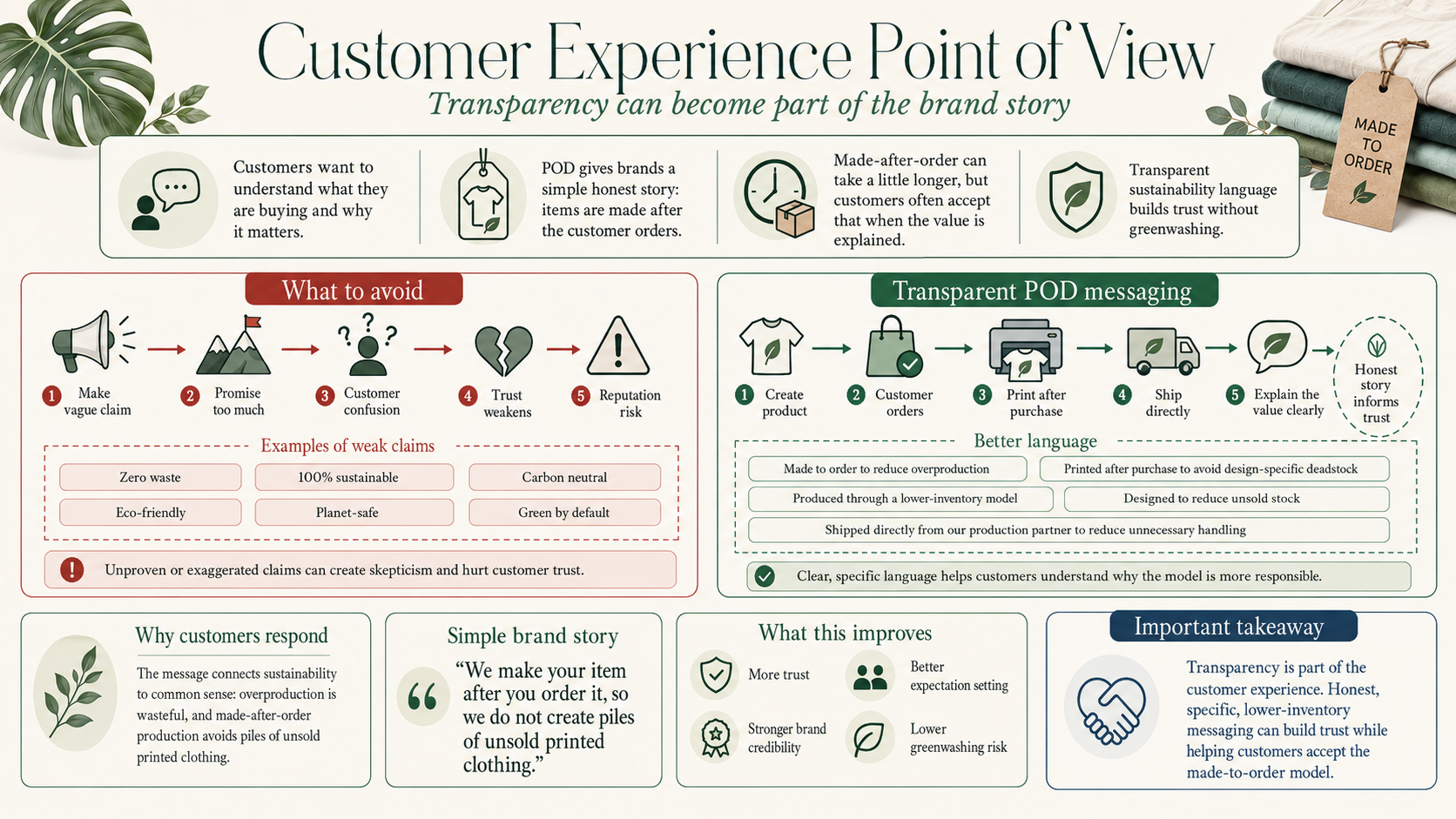
Customers increasingly want to understand what they are buying and why it matters. POD gives fashion brands a simple, honest story:
“We make your item after you order it, so we do not create piles of unsold printed clothing.”
That message is easy to understand because it connects sustainability to common sense. Customers know overproduction is wasteful. They understand that a made-after-order model may take slightly longer, and many will accept that wait if the value is clearly explained.
The key is transparency. A POD brand should avoid exaggerated claims like “zero waste,” “100% sustainable,” or “carbon neutral” unless it can prove them. Better language would be:
“Made to order to reduce overproduction.”
“Printed after purchase to avoid design-specific deadstock.”
“Produced through a lower-inventory model.”
“Designed to reduce unsold stock.”
“Shipped directly from our production partner to reduce unnecessary handling.”
This kind of communication builds trust without greenwashing.
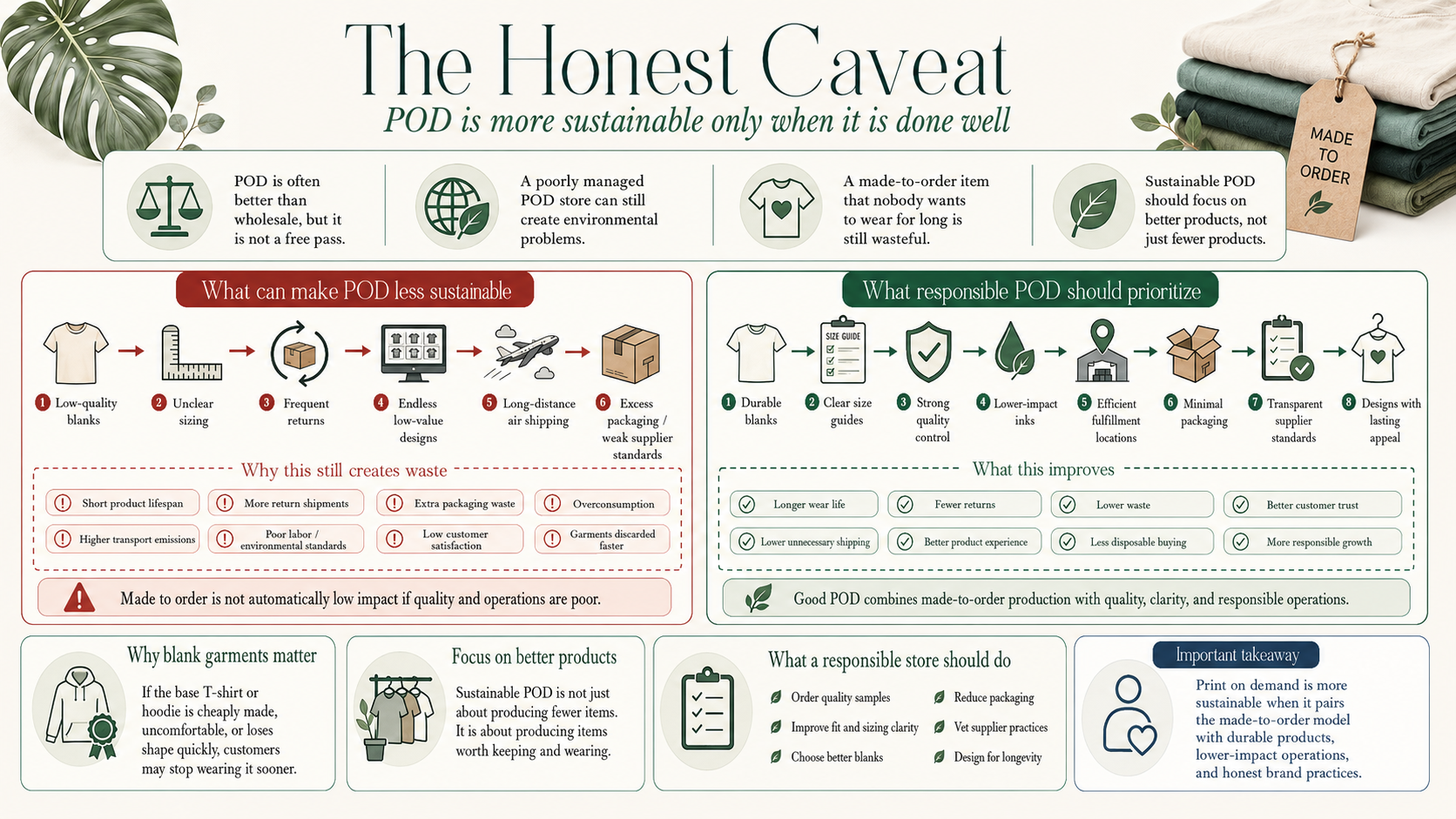
11. The Honest Caveat: POD Is More Sustainable Only When It Is Done Well
Print on demand is a better workflow than wholesale in many situations, but it is not a free pass. A poorly managed POD store can still create environmental problems.
POD can become less sustainable if the garments are low quality, customers return products often because sizing is unclear, the brand encourages overconsumption with endless low-value designs, every order is shipped long-distance by air, packaging is excessive, or suppliers lack good labor and environmental standards.
The blank garment matters too. If the base hoodie or T-shirt is cheaply made, uncomfortable, or loses shape after a few washes, the product may be discarded quickly. A made-to-order item that nobody wants to wear for long is still wasteful.
This is why sustainable POD should focus on better products, not just fewer products.
A responsible POD fashion store should prioritize durable blanks, clear size guides, strong quality control, lower-impact inks where possible, efficient fulfillment locations, minimal packaging, transparent supplier standards, and designs with lasting appeal.
12. When Wholesale Still Makes Sense
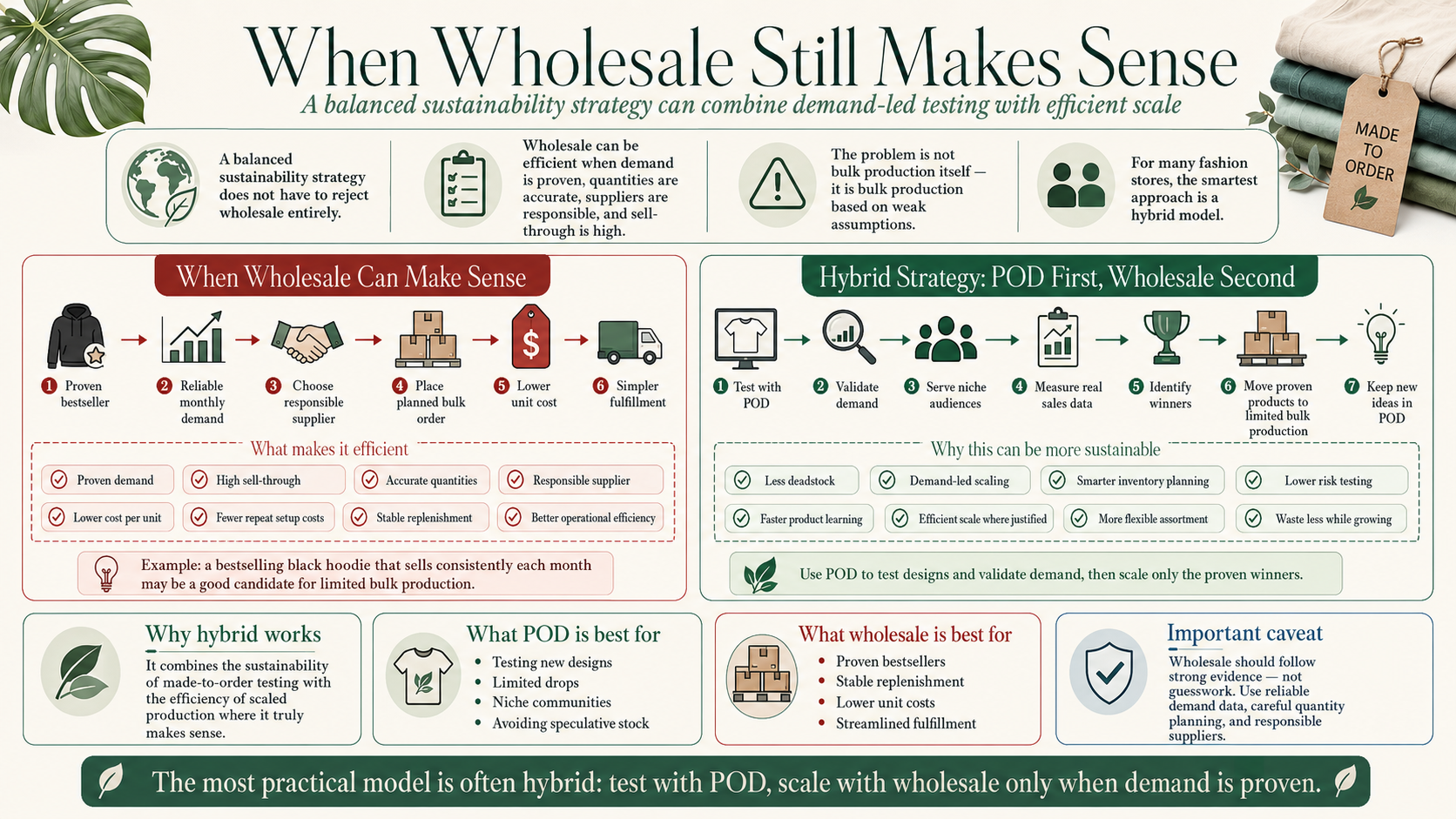
A balanced sustainability strategy does not have to reject wholesale entirely. Wholesale can be efficient when demand is proven, quantities are accurate, suppliers are responsible, and sell-through is high.
For example, if your brand has a bestselling black hoodie that sells consistently every month, a carefully planned bulk order from an ethical supplier may reduce unit costs and simplify fulfillment. The problem is not bulk production itself. The problem is bulk production based on weak assumptions.
The smartest model for many fashion stores is hybrid:
Use POD to test designs, validate demand, serve niche audiences, and avoid deadstock. Then use limited wholesale or bulk production only for proven bestsellers with reliable demand data.
That approach combines the sustainability of demand-led production with the efficiency of scaled production where it actually makes sense.
Conclusion: The Sustainable Advantage Is the Workflow
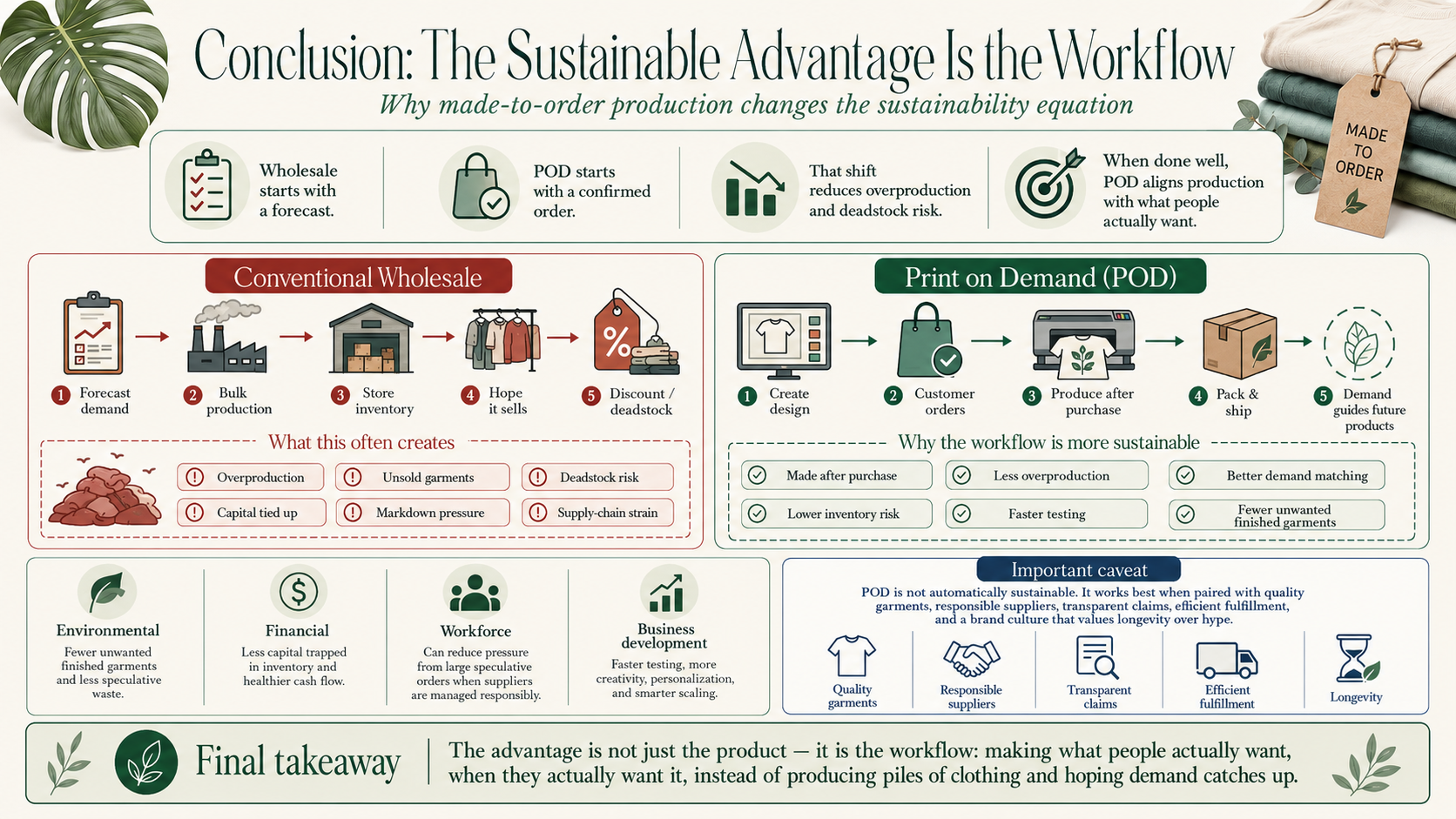
Print on demand is more sustainable than the conventional wholesale model because it changes the starting point of production. Wholesale begins with a forecast. POD begins with a confirmed order.
That difference reduces overproduction, lowers the risk of deadstock, protects cash flow, supports more agile product development, and can reduce some of the supply-chain pressures associated with large speculative orders. For printed clothing, where designs can be trend-driven, personal, seasonal, or niche, the made-to-order model is especially powerful.
The environmental benefit is clear: fewer unwanted finished garments. The financial benefit is clear: less capital trapped in inventory. The workforce benefit is possible when brands choose responsible suppliers and avoid unrealistic fulfillment pressure. The business development benefit is strong: faster testing, more creativity, better personalization, and smarter scaling.
POD is not automatically sustainable. It must be paired with quality garments, responsible suppliers, transparent claims, efficient fulfillment, and a brand culture that values longevity over hype. But when done well, print on demand gives fashion entrepreneurs a better foundation: a store that makes what people actually want, when they actually want it, instead of producing piles of clothing and hoping the market catches up.

Hi, this is a comment.
To get started with moderating, editing, and deleting comments, please visit the Comments screen in the dashboard.
Commenter avatars come from Gravatar.